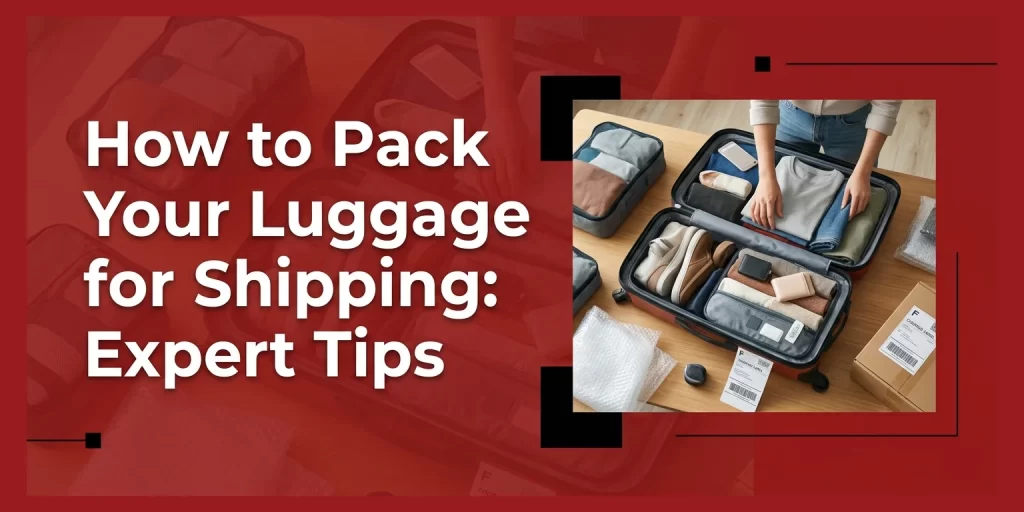
Why Packing for Courier Shipping Is Different
The instinct when packing for shipping is to do what you’d do for a flight — fold things neatly, zip the bag, done. The result is often items that arrive dishevelled, shifted, or damaged in ways that a flight bag wouldn’t be.
Here’s why courier shipping requires a different approach:
- Multiple handling events: A courier shipment is handled 5–8 times between collection and delivery. Each handling event is a potential impact. Packing must survive cumulative handling, not a single careful transfer
- Stacking pressure: At sorting facilities, packages are stacked. A suitcase or box at the bottom of a stack bears the weight of everything above it. Soft-sided bags offer no resistance to this. Rigid boxes distribute load
- Temperature and humidity variation: Air cargo holds are not climate-controlled in the same way passenger cabin baggage areas are. For sensitive electronics, instruments, or items that could warp, condensation or temperature change is a real factor
- Duration: A domestic shipment takes 24–48 hours. An international shipment can take 7–14 days. Items in transit for two weeks need to be packed for a two-week journey, not a 45-minute flight
- No retrieval mid-journey: If something comes loose inside a checked airline bag, you discover it at the carousel. If something shifts in a courier box mid-transit, you find out at delivery. There is no mid-journey intervention
The one-test rule: Before sealing any box or bag, pick it up and shake it firmly in all directions. Nothing should move. If you can hear or feel anything shifting, it needs more padding. This single test catches most packing failures before they become problems in transit.
The Right Packing Materials — and What Not to Use
The quality of your packing materials determines most of the outcome. Professional-grade materials are not expensive — they’re available at stationery shops and courier supply outlets across Delhi — and the cost difference between adequate and inadequate materials is typically a few hundred rupees. Against the cost of a damaged shipment, it’s not a meaningful consideration.
Materials that work
- Double-wall corrugated cardboard boxes: The foundation of any courier shipment. Double-wall construction has two layers of corrugation, giving it four times the compression resistance of single-wall. Use these for everything. Do not use single-wall boxes, thin supermarket boxes, old fruit boxes, or pizza boxes for courier shipments that will be in transit for more than a few hours
- Bubble wrap (large and small cell): Large-cell bubble wrap (2.5 cm bubbles) provides cushioning for heavy items and initial wrap layers. Small-cell bubble wrap (1 cm bubbles) is better for wrapping individual fragile items and filling irregular spaces. Keep both types
- Foam pipe insulation: The most underrated packing material. Available at any hardware shop for a few rupees per metre. Cut to length and use to protect the edges of frames, the corners of electronics, the rims of crockery, the shafts of golf clubs, the body of guitars. Better edge protection than bubble wrap alone at a fraction of the cost
- Foam sheets and foam inserts: Cut-to-size foam sheets provide base and top padding in boxes. Foam inserts cut to fit around specific items (cameras, instruments) are the best protection available for high-value goods
- Packing peanuts or air pillows: Effective void fill for large boxes. Air pillows are easier to work with and don’t leave polystyrene residue. Packing peanuts work but shift over time — top up the box densely and seal well
- Stretch wrap (cling film / stretch foil): Wrapping the outside of a suitcase or soft bag in 3–4 layers of stretch wrap accomplishes several things: prevents the bag from opening, keeps dust and moisture out, makes the bag harder to tamper with, and adds a layer of pressure resistance. Standard household cling film works but industrial stretch foil from a packaging shop is better
- Quality packing tape (48–72 mm wide): The seal on a box is only as strong as the tape holding it. Use wide, strong packing tape — not standard stationery tape, not masking tape, not duct tape. Tape all seams: top centre, both ends of the top, bottom centre, both ends of the bottom. For heavier boxes, add a full wrap of tape around the box’s circumference
Materials that don’t work — avoid these
- Single-wall cardboard boxes: Crush under stacking pressure. Not suitable for any courier shipment of fragile or valuable contents
- Old or damp boxes: Cardboard degrades quickly with moisture. A box that has been stored in a damp area has reduced compression resistance. Use new boxes for courier shipments
- Newspaper as padding: Compresses completely under any pressure and provides essentially no cushioning. Print ink can also transfer to light-coloured fabrics. Use bubble wrap or foam instead
- Standard household cling film for external wrapping: Works in a pinch but tears easily and doesn’t provide the tensile strength of proper stretch foil
- Polythene shopping bags as internal void fill: Provide no cushioning. Shift completely in transit. Don’t use them
How to Pack a Suitcase for Courier Shipping
The first question is whether to use a suitcase at all. For many courier shipments, a well-packed cardboard box is actually better protection than a soft-sided suitcase. But suitcases work well for clothing, soft goods, and personal effects — provided they’re prepared correctly.
Hard-shell suitcases
- Remove loose items from external pockets: External pockets on hard-shell cases are a vulnerability. Zip them shut and tape them closed with packing tape if the zipper can’t be locked
- Fill internal space completely: Roll clothes densely and pack tightly enough that contents cannot shift when the case is tilted or shaken. Every gap should be filled — with socks, rolled clothing, bubble wrap, or foam. This is not about cramming — it’s about eliminating internal movement
- Protect fragile items inside: Wrap anything breakable individually in bubble wrap before placing in the case. Do not rely on the case shell alone to protect fragile items inside
- Lock and tape the case: Use TSA-approved locks if shipping to the USA (customs may need to open the case). For all other destinations, standard combination locks are fine. Additionally, wrap 2–3 layers of stretch wrap around the outside of the closed and locked case. This prevents the case from popping open if a corner is stressed
- Bag the suitcase: For long-distance or international shipments, place the stretch-wrapped suitcase inside a large polythene bag (available from luggage shops) before placing it in a box or shipping it as-is. This protects against moisture and surface abrasion
Soft-sided suitcases and holdalls
Soft-sided bags offer no structural protection. They’re suitable for carrying to the airport but are not adequate packaging for a courier shipment by themselves — particularly for anything fragile or valuable inside.
- For clothing and soft goods only: wrap the entire bag in stretch foil (4–5 layers) and then optionally bag it inside a polythene bag. The stretch wrap creates a firm outer shell and prevents the bag from snagging or opening
- For any hard or fragile items inside a soft bag: either remove those items and pack them separately in a rigid box, or box the entire soft bag in a double-wall cardboard box with padding on all sides
- Do not ship electronics, crockery, or anything breakable in a soft bag by itself — the bag provides zero protection against compressive force
The suitcase vs. box question: If your suitcase is large and fairly empty, its dimensional weight (L×W×H ÷ 5,000) may be significantly higher than its actual weight, increasing your courier cost. Packing a dense, smaller double-wall box can reduce both dimensional weight and improve protection for non-clothing items. Ask MBE Delhi to compare options when you get a quote.
How to Pack Cardboard Boxes for Courier Shipping
Boxes packed correctly arrive intact. Boxes packed incorrectly have predictable failure points. Here’s how to do it right for each step of the process.
Step 1 – Choose the right box size
The box should be slightly larger than the items going inside — enough room for padding on all sides (minimum 5–8 cm on each face), but not so large that items are floating in empty space. Oversized boxes with sparse contents collapse inward under stacking pressure. Undersized boxes strain at the seams and leave items without adequate padding clearance.
Step 2 – Reinforce the base
Before adding any contents, tape the bottom of the box on the inside with one strip of tape along the centre seam, and tape the outside bottom with the H-tape method: one strip along the centre seam, one strip across each end perpendicular to the first. For heavy boxes (over 15 kg), add a second strip of tape alongside the first on the centre seam.
Step 3 – Create a base layer of padding
Place a 5–8 cm layer of padding at the base of the box before any contents. Bubble wrap sheets, foam sheets, or crumpled packing paper all work. This cushions against impacts from below — the direction boxes most often receive hard handling (being set down).
Step 4 – Pack heaviest items first, at the bottom
Books, kitchen equipment, shoes, and dense items go at the bottom. Lighter items — clothing, soft goods, documents — go on top. This creates a stable centre of gravity and prevents heavy items from settling on top of fragile ones during transit.
Step 5 – Wrap and separate everything individually
Every item that could be damaged goes in its own bubble wrap before being placed in the box. Wrap fragile items with a minimum of 2–3 layers of small-cell bubble wrap and secure with tape. Items wrapped individually cannot damage each other even when the box is shaken. Items placed unwrapped next to each other absolutely can.
Step 6 – Fill every gap
No gaps. No spaces. No voids. When you’ve placed all your items, fill every remaining space with packing peanuts, air pillows, crumpled bubble wrap, or foam. The box should not make any sound or feel any movement when shaken firmly. If it does, add more fill material. This is the single most important thing you can do after wrapping individual items.
Step 7 – Seal the top
Close the flaps in the standard sequence: short flaps first, then long flaps over the top. Tape with the H-method on top (same as the base). For any box you’re not completely confident in, add a full wrap of tape around the circumference of the box — once horizontally around the middle and once diagonally. Overdoing the tape is never a problem.
Step 8 – Label clearly
Every box needs: your full name and Delhi address; recipient’s full name and destination address; contact phone for both; brief description of contents (e.g., ‘Clothes and books — personal effects’). Write ‘FRAGILE’ and ‘THIS SIDE UP’ on all four sides of any box with breakable contents. Use waterproof label covers or seal labels under tape. Labels that fall off in transit cause significant delays.
Item-by-Item Packing Guide
Different items have different vulnerability profiles. Here’s how to pack the most commonly shipped categories correctly.
Clothing and textiles
- Roll, don’t fold: Rolling clothes (the ranger roll technique) reduces creasing, creates a denser pack, and allows clothes to fill irregular spaces more effectively. Folded clothes develop pressure creases and leave gaps
- Vacuum packing bags for bulk: For bulky winter items — coats, jumpers, thick blankets — vacuum packing bags reduce volume dramatically. Useful for managing dimensional weight on large-volume soft goods shipments
- Protect delicate fabrics: Silk, fine wool, and embroidered items should be wrapped in acid-free tissue paper before placement. This prevents snags, colour transfer from adjacent items, and stress on embroidery
- Shoes: Stuff shoes with socks or paper to maintain shape. Wrap each shoe individually in bubble wrap or place in a shoe bag. Pair them sole-to-sole and band together before wrapping. Pack at the base of the box/suitcase
Electronics
- Original box is best: If you have the original manufacturer’s box with foam inserts, use it. It was designed to protect that specific item
- Without the original box: Wrap the device in anti-static bubble wrap (the pink or black kind — not standard clear bubble wrap, which can generate static charge damaging to sensitive electronics). Place in a rigid box with 5+ cm of foam or bubble wrap on all six faces
- Laptops specifically: Remove from sleeve. Wrap screen in a layer of soft cloth, then bubble wrap. Wrap body in bubble wrap. Place in a box with foam inserts cut to size or dense bubble wrap on all sides. The screen is the most fragile component — ensure it cannot flex under pressure
- Cables and accessories: Bundle cables neatly with cable ties. Wrap in a separate layer of bubble wrap and place in the box alongside the device — not loose where they can scratch
- Remove loose batteries: Take out all removable batteries before shipping. They cannot be shipped loose as cargo. Devices with integral batteries (laptops, phones) should be switched off
- Declare accurately: Electronics are a high-duty-risk category for customs. Declare at current replacement value, not purchase price
Kitchen equipment
- Pressure cookers: Remove the gasket and pressure valve. Wrap body and lid separately in bubble wrap. Place a layer of foam or bubble wrap inside the body to prevent rattling. The lid should be secured so it cannot rotate and contact the cooker body during transit
- Tawas and flat items: Stack tawas with a layer of bubble wrap between each. Bundle with tape. Stand upright in the box rather than flat — flat-stacked metal items can deform the box base under weight
- Grinders and blenders: Remove blade assembly entirely. Wrap blade in thick layers of bubble wrap and tape — blades are both sharp and fragile. Pack blades separately from the motor body in a clearly labelled small box or pouch
- Crockery and glassware: The highest risk item in any kitchen shipment. Wrap each piece individually in 3–4 layers of small-cell bubble wrap. Stack plates vertically (on edge), never horizontally. Nest bowls with bubble wrap between each. No two unwrapped items should touch each other. Double-box: packed inner box inside a larger outer box with foam or bubble wrap on all sides between the two boxes
- Spice containers: Ensure all spice containers are tightly sealed — lid and, for tins, verify the lid is not just friction-fit. Wrap in polythene bags before bubble wrapping to contain spills. A spice leak into a box ruins other contents
Books and documents
- Pack spine-down: Stand books with spines pointing to the base of the box — the same orientation as a shelf. This distributes weight through the strongest part of the book binding
- Alternate spine directions: Alternate left and right spines in each layer for stability. Books packed with all spines in the same direction can cascade like a deck of cards if one shifts
- Weight limit per box: Books are dense. A 45×45×45 cm box of books can weigh 25–30 kg, which is challenging to handle. Consider mixing books with lighter items or using smaller boxes. Check the carrier’s maximum single-piece weight limit — typically 30 kg for standard parcels
- Documents: Place in rigid cardboard envelopes or waterproof document pouches. Label the outside ‘Documents — Do Not Bend’. Place flat on top of the box contents (not at the bottom under heavy items)
Fragile items — crockery, glass, ceramics
- The double-box method is mandatory: Wrap each item individually in 3–4 layers of small-cell bubble wrap. Pack in an inner box with no internal movement. Place inner box inside a larger outer box with minimum 8 cm of foam or bubble wrap on all sides. Seal both boxes thoroughly
- Never rely on a single layer of packaging: A single box of crockery wrapped in bubble wrap is not sufficient for courier shipping. The inner box distributes impact before it reaches individual items. Without it, a single hard impact can shatter multiple items
- Plates on edge, not flat: Flat-stacked plates crack under compressive load. Plates standing on edge flex and absorb impact without fracture. This is the most commonly ignored advice for crockery and the most consequential
- Label every face: FRAGILE and THIS SIDE UP on all four vertical sides and the top of the box
Valuables — jewellery, watches, cash
High-value jewellery and watches should travel with you personally where possible — in your carry-on. If you’re shipping them via courier, use MBE Delhi’s valuables shipping service with declared value insurance. The packing requirements for valuables are specific:
- Place each item in its original case or a padded jewellery pouch
- Layer multiple items in a rigid box with foam inserts cut to shape — items should not touch each other
- Do not label the outside as ‘Jewellery’ or ‘Valuables’ — use a neutral description such as ‘Personal effects’
- Declare accurately and insure to full replacement value
- Do not ship undeclared cash — see the restrictions guide for Indian currency export limits
Musical instruments
- Guitars: Loosen strings to half-tension before packing (string tension changes with temperature and pressure). Place guitar in its hard case with the neck supported by foam inserts or a foam block. Pack additional bubble wrap or foam inside the case to prevent the guitar from shifting. Place the hard case in a box with foam padding on all sides
- Tablas and percussion: Protect the drum skin — it is fragile under direct pressure. Wrap skins in multiple layers of bubble wrap and secure a rigid circular disc (cardboard or thin foam) over each skin before packing. The drum body is generally robust but the skin is not
- Wind instruments: Ship in their original cases with additional padding inside. Keys and valves are fragile mechanisms — ensure they cannot move within the case. Remove and pack mouthpieces separately, wrapped in bubble wrap
Don’t Forget: Documentation Inside and Outside the Box
Packing materials and technique protect your items. Documentation protects your shipment as a whole — particularly for international parcels that must pass through customs.
Inside every box
- An itemised contents list: every item in the box, quantity, and approximate current value
- Your name and the destination address (belt-and-suspenders backup if external labels are damaged)
- For international shipments: a copy of the full packing list and customs declaration
On the outside of every box
- Sender: full name, full Delhi address, phone number
- Recipient: full name, full destination address, phone number
- Contents description (brief — ‘Clothes and books — personal effects’)
- FRAGILE / THIS SIDE UP as applicable
- Box number out of total (Box 1 of 4, Box 2 of 4) for multi-box shipments
Photograph everything before sealing
Before sealing each box, photograph its contents. Open the suitcase and photograph what’s inside. Do this for every container in your shipment. These photographs are your insurance baseline. If a claim is made, the photographs are the primary evidence of what was in the shipment and its pre-transit condition. Without photographs, claims are harder to process and often result in lower settlements. The whole photographic process takes 10–15 minutes and is one of the highest-value things you can do before a courier collection.
The 10 Most Common Packing Mistakes — and How to Avoid Them
| Mistake | What Goes Wrong | What to Do Instead |
| Using single-wall boxes | Box crushes under stacking weight | Double-wall boxes only for all courier shipments |
| Newspaper as padding | Compresses immediately — zero cushioning | Bubble wrap, foam sheets, air pillows |
| Leaving empty space in boxes | Contents shift and impact each other | Fill every gap — shake test before sealing |
| Stacking plates flat | Cracks under compressive load | Pack plates on edge (vertically), always |
| Single-boxing fragile items | One impact breaks multiple items | Double-box method for all ceramics and glass |
| Shipping loose batteries | Shipment refused or intercepted; fire risk | Remove all batteries; take power banks in carry-on |
| Vague external labels | Delivery delays if label is damaged | Label all faces; include a backup label inside |
| No photos before sealing | Insurance claims difficult to process | Photograph contents of every box before closing |
| Overfilling / overweight boxes | Box seams fail; handling injuries risk | Max 20–25 kg per box; distribute weight across multiple boxes |
| Not sealing suitcase zippers | Bag opens in transit; contents lost | Lock and stretch-wrap all suitcases before shipping |
When to Pack Yourself vs. When to Use Professional Packing
Self-packing is fine for most standard luggage shipments. Professional packing adds cost but is worth it in specific circumstances. Here’s an honest guide to the decision:
Self-packing is fine when
- You’re shipping clothing, books, and standard household goods in double-wall boxes
- No item individually is worth more than ₹25,000–₹30,000
- Nothing is particularly fragile — standard kitchen equipment, soft goods, documents
- You have time and proper materials available
- You’ve packed for courier shipments before and know what you’re doing
Use professional packing when
- Fragile items: Crockery, glassware, ceramics, mirrors, framed artwork. Our team uses double-box method and appropriate materials as standard practice
- High-value electronics: A ₹1.5 lakh laptop or ₹80,000 camera system deserves professional packing. We use foam inserts cut to spec, not generic bubble wrap
- Musical instruments: Guitars, tablas, sitars, wind instruments — packing these correctly requires knowing instrument-specific vulnerabilities
- Sports equipment: Bicycles, golf clubs, skis — each has specific disassembly and padding requirements that prevent the common points of damage
- You’re unsure: If you’re uncertain about how to pack something, it’s worth asking. The cost of professional packing is usually a fraction of the cost of replacing a damaged item
- Insurance purposes: Professionally packed shipments have better-documented pre-transit condition and a clearer claim path if something goes wrong. For high-value shipments, this matters
MBE Delhi’s professional packing service comes to your home or office in Delhi — you don’t need to bring items to us. Our team assesses what needs to be shipped, brings the appropriate materials, packs to carrier standards, and documents the pre-transit condition. For anything valuable, fragile, or oversized, it’s the approach that reliably results in items arriving intact.
MBE Delhi: Professional Packing and Shipping from Delhi
MBE Delhi provides professional packing and courier services across India and to 60+ countries worldwide. We pack and ship luggage, personal effects, sports equipment, business materials, and valuable items — from our base in Delhi, with home collection available across Delhi and the NCR.
The packing tips in this guide are what our team applies every day. For shipments where you want the job done correctly without handling it yourself, we’re the team to call.
Relevant services
- Professional Packing Services — At-home packing using the right materials for every item type
- Valuables & Antiques — Specialist handling and insurance for high-value personal effects
- International Courier — Door-to-door shipping to 60+ countries with full customs support
- Domestic Courier — Pan-India tracked delivery, 24–48 hours on major metro routes
- Outsource Your Logistics — For businesses and frequent shippers with recurring packing and shipping needs
To book a packing service or get a shipping quote, contact MBE Delhi.
Pre-Shipment Packing Checklist
Run through this before every courier collection:
- Materials ready: Double-wall boxes, bubble wrap (large and small cell), foam pipe insulation, packing tape (48mm+), stretch wrap, void fill
- Items wrapped individually: Every breakable item in its own bubble wrap, secured with tape
- Heavy items at the base: Heaviest items packed first, at the bottom of each box or suitcase
- All gaps filled: No movement when box is shaken — fill with foam, air pillows, or bubble wrap until nothing moves
- Batteries removed: All removable batteries taken out; all devices switched off; no power banks
- Boxes sealed with H-tape method: Top and base sealed properly; full circumference wrap added for heavy or valuable boxes
- Suitcases locked and stretch-wrapped: Locked, zippers taped, then 3–4 layers of stretch foil around the outside
- Labels on all faces: Sender and recipient details; FRAGILE / THIS SIDE UP where applicable; box number
- Contents list inside each box: Item-level list with approximate values — for customs and insurance
- Photos taken: All contents photographed before sealing; photos saved and backed up
Good Packing Is What Makes Shipping Reliable
Everything else in the courier shipping process — carrier selection, tracking, customs documentation — depends on the shipment arriving at the destination in the same condition it left. That starts with how it’s packed.
The techniques in this guide aren’t complicated. They require care, the right materials, and the discipline to do the shake test before sealing. Items packed this way travel 10,000 km and arrive intact. Items packed carelessly travel 500 km and arrive damaged.
If you’d rather not handle the packing yourself, MBE Delhi’s professional packing team will do it correctly, at your home or office, before collection. Either way — pack well, ship confidently.